
Braddock's Point Plantation – Hilton Head Island – Beaufort County
Basic Information
- Location – Hilton Head Island, Beaufort County
In Sea Pines Plantation, a present-day real estate development, 84 Baynard Park Road at Plantation Drive
- Origin of name – Named for Captain David Cutler Braddock, commander of the colonial half-galley Beaufort in 1742.
- Other names – Braddock Cove, Calibogue Point, Stoney-Baynard Hall
- Current status – Listed on National Register of Historical Places – owned by Sea Pines Plantation Company
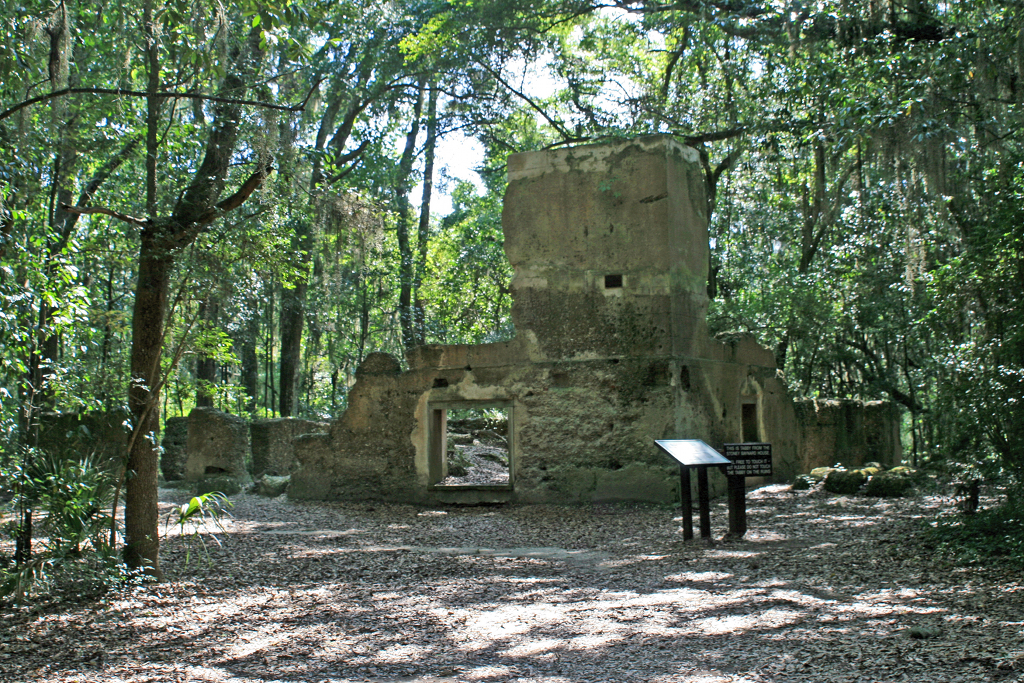
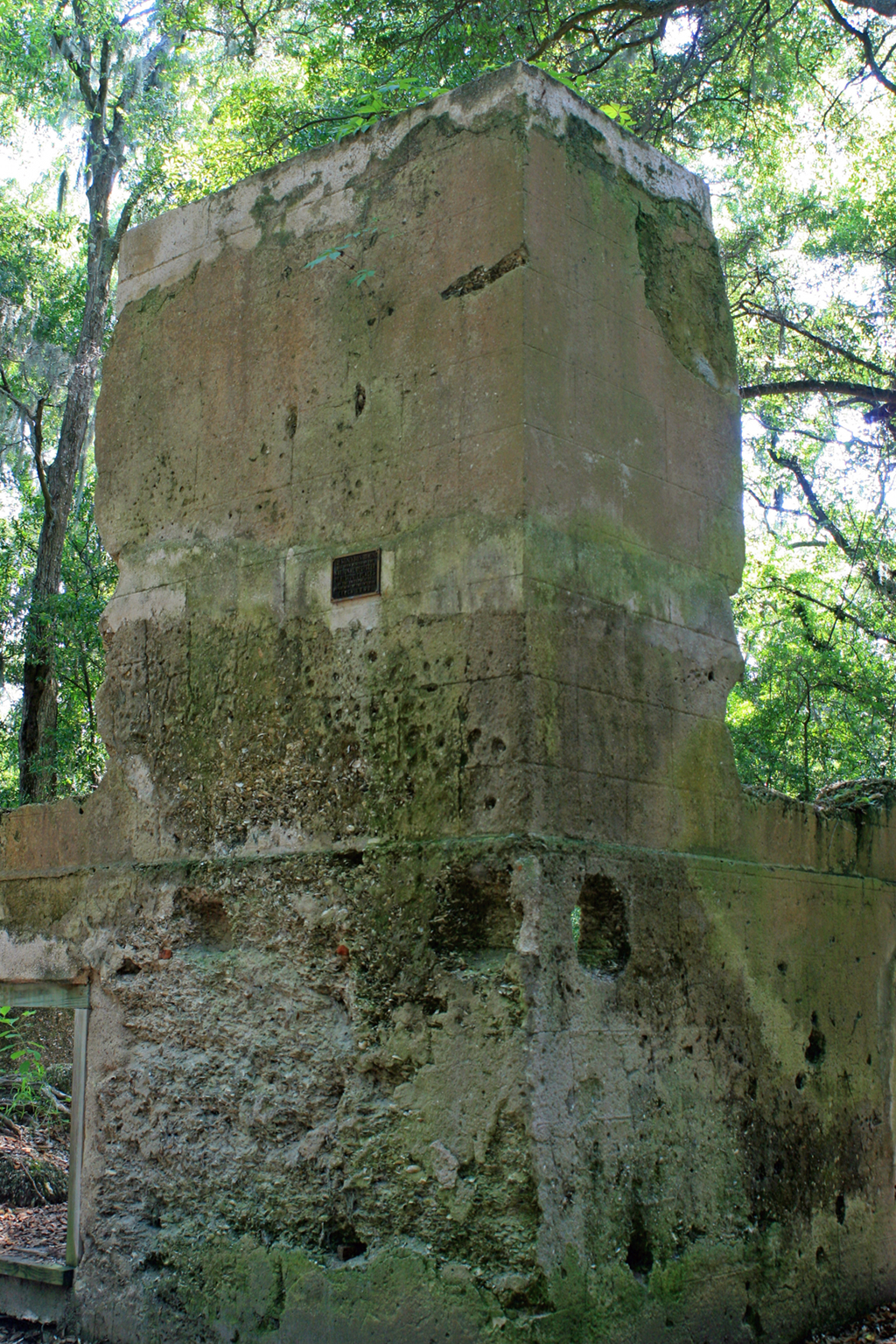
"Today, the tabby structure is comprised of a foundation and the outer structure or shell of the home. Seen from a distance, the ruins seem blurred. Up close, the thousands of oyster shells create a honeycomb, a complex texture that is simultaneously pocked and smooth. There are windows that look like ancient portholes, and bits of stucco still cling to the tabby. The effect is not unlike that of a medieval abbey or a Roman ruin, the remnants of a dream (4)."

Timeline
- ? – Earliest known date of existence
Plantation was "composed of Lots 46 and 47 of Bayley's Barony [owned by Peter Bayley] [and] described as lands formerly leased by John Gamble and James Gray" (7). A different source has the plantation being Lots 13 and 14 of Bayley's Barony. Bayley's Barony would later be owned by John Bailey (10).
The property was seized by the state after the Revolutionary War and was later returned to John Bailey's heir Benjamin Bailey (10).
- ? – John Mark Verdier, a merchant in Beaufort, acquired the land (11).
- 1776 – Captain James Stoney purchased Braddock's Point Plantation from Verdier (11).
- 1793-1820 – House built by James Stoney
Historians differ on exact date. The South Carolina Institute of Archeology & Anthropology frames construction between 1800 and 1820. Another estimate falls as early as 1793, while author Robert Peeples states that "the Braddock Point Plantation house apparently was built by the Stoney's around 1796" (7).
- 1827 – James Stoney died on February 10 leaving the plantation, and a large amount of debt, to his brother Captain John Stoney (10).
- 1830s – John Stoney died leaving the plantation to Dr. George Mosse Stoney. John had mortgaged the property through the Bank of Charleston shortly before his death (10).
- Circa 1838 – Dr. George Mosse Stoney gave the plantation to his eldest son "Saucy Jack" (given name unknown) (11).
- 1845 – At some point, the Bank of Charleston took possession of the plantation and sold it to William Eddings Baynard for $10,000 (10).
- 1849 – William Eddings Baynard passed away and Braddock's Point was left to his son Ephraim Baynard (10).
- November 10-11, 1861 – Civil War engagement. Records show the Union Army used the house as late as 1864 (9) (10).
- 1867 – Stoney-Baynard Hall burned sometime between the middle of August and the middle of December (8).
- Late 1860s – Like other plantations in South Carolina, the Civil War took a toll on the plantation's value. The Baynard family was unable to pay the $155 tax bill on the property that was valued at $4,000 and the Federal government took possession of the plantation, paying $845 for it (10).
- 1875 – The Baynards were able to reclaim the plantation on August 2 except for the point which the government kept for a light house (10).
- 1894 – William P. Clyde bought the property for $4,683 on February 19 (10).
- 1919 – Roy A. Rainey purchased the plantation (10).
- 1931 – The property was sold to Thorne and Loomis (10).
- 1951 – The Hilton Head Company purchased the plantation which has since been developed into Sea Pines Plantation (10).
Land
- Number of acres – 1,000 (at least from 1776 to 1840); 1,500 in 1867 (10)
- Primary crops – Cotton, corn, peas, sweet potatoes (10)
The plantation also sold butter (10).
Slaves
- Number of slaves – The Baynard family claimed the loss of 129 slaves during the Civil War (10)
In 1838 there were 22 slave quarters and a driver's house (10).
Buildings
- House – The walls were two feet thick and constructed from tabby, "a mixture of oyster shells, some whole and others burnt to a lime powder, as well as sand and water (7)."
More about tabby plus photograph
References & Resources
- National Register of Historic Places
– Nomination form - PDF - submitted in 1994
– Photographs, architectural overview
- The Stoney-Baynard Ruins: The Story of the Ruins
- Stoney-Baynard Ruins Slave Dwelling, Stoney-Baynard Ruins - scroll down
- BestRead Guide's Stoney-Baynard Ruins - no longer online
- Claude Henry Neuffer, editor, Names in South Carolina, Volume I through 30 (Columbia, SC: The State Printing Company)
 Order Names in South Carolina, Volumes I-XII, 1954-1965
Order Names in South Carolina, Index XIII-XVIII
- Trinkley, Chicora Foundation Research Series #24, Preliminary Historical Research on the Baynard Plantation, Hilton Head Island, Beaufort County, South Carolina, pages 15-17
- Robert Peeples, An Index to Hilton Head Names (Before the Contemporary Development)
- Natalie Adams, Michael Trinkley, and Debi Hacker, Chicora Foundation Research Series 40: In the Shadow of the Big House: Domestic Slaves at Stoney/Baynard Plantation, Hilton Head Island
- United States War Department, The War of the Rebellion: A Compilation of the Official Records of the Union and Confederate Armies
(Ithica, NY: Cornell University Library, 2009)
- The Heritage Library Foundation - Stoney-Baynard Plantation
- Capitan John Stoney - genealogy posting


More about Beaufort County
- Learn more about historic Beaufort County, including the lovely town of Hilton Head as well as Beaufort SC. We have helpful guides to Hilton Head history and Hilton Head libraries and museums – plus Hilton Head restaurants, Hilton Head bed & breakfasts, Hilton Head hotels, and Hilton Head real estate.